
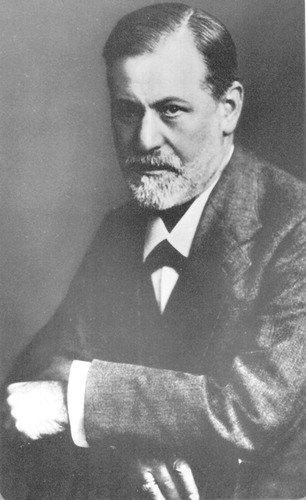
Sigmund Freud, 1856–1939
Sigmund Freud was born in 1856 in Moravia (now part of Czechoslovakia). Influenced by physiologist Hermann Helmholtz, he set out to apply the laws of physics to the human nervous system. His interest in neurology gradually gave way to pioneering efforts to understand unconscious influences on our behavior in illness and health. He studied with Brucke, Meynert, and Charcot, but Freud ultimately blazed a new trail of research and therapy that came to be known as psychoanalysis. When his efforts to retrieve the contents of the unconscious mind through hypnotically induced abreaction failed to produce lasting therapeutic results, Freud turned to the systematic analysis of the patient’s free associations to learn more about the unconscious factors that produced the symptoms of hysteria. This approach led him to replace the topographic model of making the unconscious conscious with the structural model of ego, id, and superego. Among his principal discoveries were transference, the displacement of past relationships onto figures in one’s current life, and resistance, the patient’s unconscious tendency to oppose the physician who is intent on helping. He was also instrumental in unlocking the mystery of dreamwork by identifying mechanisms such as condensation, displacement, symbolic representation, and secondary revision. Psychoanalysis and psychodynamic psychotherapy (derived from psychoanalysis) are now practiced throughout the world. Few thinkers have played so central a role in the last century’s intellectual and cultural life. While some of Freud’s ideas have required revision, modern neuroscience has confirmed many of his basic tenets. Freud predicted that psychoanalytic understanding would ultimately be wedded to breakthroughs in the study of brain mechanisms, and his dream is now coming to fruition.
Address reprint requests to Dr. Gabbard, Department of Psychiatry, Baylor College of Medicine, One Baylor Plaza, Houston, TX 77030; [email protected] (e-mail). Photo used with permission of the Kansas State Historical Society, Topeka, Kan.
Sigmund Freud